
Activity 2.4.3.
(a)
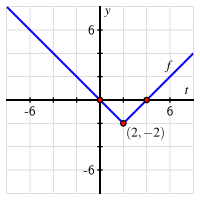
On the same axes as the plot of \(y = f(t)\text{,}\) sketch the following graphs: \(y = h(t) = f(\frac{1}{3}t)\) and \(y = j(t) = f(4t)\text{.}\) Be sure to label several points on each of \(f\text{,}\) \(h\text{,}\) and \(j\) with arrows to indicate their correspondence. In addition, write one sentence to explain the overall transformations that have resulted in \(h\) and \(j\) from \(f\text{.}\)
(b)
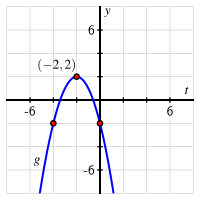
On the same axes as the plot of \(y = g(t)\text{,}\) sketch the following graphs: \(y = k(t) = g(2t)\) and \(y = m(t) = g(\frac{1}{2}t)\text{.}\) Be sure to label several points on each of \(g\text{,}\) \(k\text{,}\) and \(m\) with arrows to indicate their correspondence. In addition, write one sentence to explain the overall transformations that have resulted in \(k\) and \(m\) from \(g\text{.}\)
(c)
On the additional copies of the two figures below, sketch the graphs of the following transformed functions: \(y = r(t) = 2f(\frac{1}{2}t)\) (at left) and \(y = s(t) = \frac{1}{2}g(2t)\text{.}\) As above, be sure to label several points on each graph and indicate their correspondence to points on the original parent function.
(d)
Describe in words how the function \(y = r(t) = 2f(\frac{1}{2}t)\) is the result of composing two elementary transformations of \(y = f(t)\text{.}\) Does the order in which these transformations are composed matter? Why or why not?

