APC: updates for Fall 2026

I’m pleased to share several news items related to Active Prelude to Calculus.

Changes for Fall 2026

Active Prelude, available at https://activecalculus.org/prelude/, has been updated to resolve any reported errors.  In addition, some of the activities have been updated slightly in ways that make them differ from the print and PDF versions, usually involving fixing mistakes or improved images; for instance, see the graphics throughout Section 1.8, such as in Activity 1.8.2.  These differences appear in HTML only.

For several years, we have offered activity solutions upon request due to work in LaTeX by Lindsay Rocks of Colorado Mountain College and South Routt School District, Julie Hoff of Colorado Northwestern Community College and South Routt School District, and Steve Schlicker of GVSU.  Chrissy Safranski and David Austin leveraged that work to add answers to the activities that now appear in the backmatter of the HTML version of the text.

A new version with interactive previews

In addition to the new, additional version of the 2E single variable calculus text, Active Calculus with Doenet, that was recently announced in another post, I’m pleased to share that we now also have a version of Active Prelude with electronic, interactive preview activities. The only differences between this and the current version posted on activecalculus.org are found in the preview activities; all of the rest of the text is identical.  

While Active Prelude has always had interactive WeBWorK exercises at the end of each section, until now the preview activities were static: there was not a straightforward way for students to get feedback on their thinking.  Chrissy Safranski has written new previews in Doenet for the entire text.  For example, see Preview Activity 2.1.1, in which a Doenet animation now helps the student interact with the ideas in the external animation linked to in the text as part of the original static preview activity.

Using the New Version

You can read and engage with Active Prelude with Doenet at the provided link.  It is also possible to create a Runestone account and a course and then assign and track student work on the previews and exercises, all for free. One key advantage of the Runestone platform is that students see the text and the interactive (Doenet) previews and (WeBWorK) exercises as fully integrated: all of the students’ work is saved in the text itself.  A forthcoming blog post will offer some additional information about using Runestone.

Chrissy Safranski is piloting this version of Prelude in her Fall 2026 precalculus course. If others are interested in joining her in using it, she welcomes hearing from you: csafranski@franciscan.edu.  Put “APC, Doenet, and Runestone” in the subject line.

Note well: the Doenet version is still a work in progress.  There will be some bugs; hopefully they’ll be minor, and we will be prompt and responsive to issues that arise.  Also, as noted above, the Doenet version is only available in HTML: the preview activities in the Doenet version are different from the currently posted PDF and print versions of the text.

Thanks

Like with the Doenet version of Active Calculus Single, there are many people to thank for their contributions that made this new version of the text possible, including:

  • Duane Nykamp, Doenet founder
  • Virginia Mae, Doenet tech support
  • Brad Miller, Runestone founder
  • Rob Beezer, PreTeXt founder
  • Oscar Levin, PreTeXt developer
  • Chrissy Safranski, co-author
  • GVSU, for sabbatical support

I’m excited for this additional resource to be available to instructors and their students and I look forward to continued development that will make APC an even better product.

More about Doenet 

Founded by Duane Nykamp of the University of Minnesota, Doenet (the Distributed Open Education Network) is an NSF-supported free, open-source platform that enables authors and instructors to create, share, and deliver richly interactive mathematics activities and exercises that provide extensive feedback to students. Among its many strengths, Doenet supports easy answer-checking of mathematical expressions, text, and even interactive graphics.  In addition, through drop-down menus it’s straightforward to create sentences with multiple fill-in-the blank options that help students provide structured reasons and explanations.  Authors can provide content that’s responsive to what students enter, including conditional feedback.  Doenet interactives can be embedded in any PreTeXt book, and student interactions with content can be tracked in the Runestone learning platform.
Posted in precalculus, Publicity, Publishing, Resources, updates | Tagged , , , | Comments Off on APC: updates for Fall 2026

ACM2E: HTML and Runestone Release!

We are pleased to announce that activecalculus.org has been updated to publish the 2nd edition. Putting your mouse over “Active Multi” in the menu will open a drop-down where you can access both the 1st and 2nd editions. Last summer, we wrote about the differences between ACM1E and ACM2E.

Ready Right Now

  • The URL activecalculus.org/multi now points to the text of the 2nd edition.
    • If you are still planning to teach from the first edition, you can simply edit any existing links you’re using so that they read activecalculus.org/multi1e/___ and they will point to the page you are accustomed to.
    • We’re nowhere near thinking about a 3rd edition yet, but if you want to future-proof yourself while teaching from the 2nd edition, you can use activecalculus.org/multi2e/___
  • The webpage about ACM has been updated to reflect ACM2E.
    • A PDF version of ACM2E is available. Creating a quality PDF of a book the length of ACM2E takes a lot of manual adjustments, especially to deal with the interactive three-dimensional graphics. Thus, you should think of this as a preview of a future print version of ACM2E. Our focus for the next 10 months will be fine-tuning the PDF version. Whenever we think we have an improved version that is worth sharing, we will update the version on the website. We generally will not announce this updated version, but the date of last build appears on the third page of the PDF with the authors.
    • A PDF version of the activities workbook for ACM2E is available. Our work on the PDF version of the book will also lead to improvements to the activities workbook, including fine-tuning the space provided for students to work in. You can also print worksheets from the HTML version of the text as described in this blog post. (Although Matt refers to ACS and APC there, this is a feature in all three books.)
  • ACM2E is now fully supported on Runestone Academy for instructors to use. You can browse ACM2E on Runestone Academy and find it in the list of books to use when you create a course.
    • Unlike ACS, the Preview Activities for ACM2E are not WeBWorK or Doenet and cannot be assigned for grading inside Runestone Academy. However, all the WeBWorK exercises can be assigned and graded in Runestone Academy.
    • We have pre-built an assignment for each section of the text containing all WeBWorK exercises. After creating your own course on Runestone Academy, you can copy these assignments into it:
      1. Go to the Instructor Dashboard.
      2. Choose Assignments & Grading and then Copy Assignments.
      3. Choose the course acmulti.
      4. We suggest copying all assignments.
      5. You can then set due dates and delete problems where you want a shorter assignment. In future semesters, you will be able to copy assignments from your past courses as well as from acmulti so you don’t have to do all the setup from our assignments each semester.
  • An instructor’s solutions manual with solutions to (most) Preview Activities, Activities, and (non-WeBWorK) exercises is available. Join the ACM Google Group to learn more about how to access the instructor’s solutions manual.
    • If you have previously gotten access to the Google Drive folder with the solutions manual, there is now an updated PDF in there for ACM2E.
  • If you have access to your own WeBWorK server and would like a bundle of .def files that you can load corresponding to the sections in the text, it is available in the same Google Drive folder as the instructor’s solutions manual.

What’s left?

  • We are working to prepare a hard copy version of ACM2E that students will be able to purchase, similar to what is available for ACS. This will also include an activities workbook for ACM2E.
    • Fine-tuned PDFs of the text and activities workbook are expected for Fall 2027 classes.
    • Purchasable hard copies are expected for Spring 2028 classes.
  • Interactive sizes need some fine-tuning even in the HTML version of the text. We are actively working on this and intend to post an improved version of the HTML version before Spring 2027 classes. We will ensure that all URLs remain stable when doing this update so that instructors do not need to worry about updating links.
Posted in calculus, updates | Tagged , | Comments Off on ACM2E: HTML and Runestone Release!

ACS2E: additional version with new and improved previews and exercises

I’m delighted to announce that a new, additional version of the 2nd edition of Active Calculus Single Variable is now publicly available on Runestone: Active Calculus with Doenet. The only differences are found in the preview activities and exercises; all of the rest of the text is identical.  

For a long time, I’ve thought that the current interactive exercises in WeBWorK didn’t quite fit the text.  I’m excited to now have a full set of exercises (with better graphical interactivity and automated answer-checking and feedback) that genuinely fit the notation, tone, and style of ACS.  

This new version is the result of many contributors: initial drafts of many of the preview activities were created with a small group of participants during week-long workshops at the University of Minnesota in 2023 and 2024.  During my Fall 2025 sabbatical, I revisited these drafts and edited them extensively, plus wrote several entirely new preview activities.  In addition, I wrote or edited over 300 new exercises.

Highlights from the new version

Here are a few sample exercises to explore and see some of the great features the new version offers:

Exercise 1.8.5.2: Using a tangent line to approximate g when given a graph for g’
Exercise 3.6.4.2: Optimizing the volume of a rectangular storage container
Exercise 5.3.6.1: Practicing the structure of u-substitution with trig functions
Exercise 7.3.5.2: Applying Euler’s Method to a differential equation involving both t and y
Exercise 8.4.5.1: Finding the Taylor series of a rational function

Here are two examples of preview activities that especially leverage Doenet’s capabilities:

Preview Activity 4.3.1 (using a built-in Riemann sum calculator)
Preview Activity 7.3.1 (Euler’s Method introduction)

Using the New Version

You can read and engage with Active Calculus with Doenet by following the link.  It is also possible to create a Runestone account and a corresponding course that uses the text, and then assign and track student work on the previews and exercises, all for free. One key advantage of the Runestone platform is that students see the text and the interactive previews and exercises as fully integrated: all of the students’ work is saved in the text itself.  Both the previously-posted version (with WeBWorK) and the new version (with Doenet) of Active Calculus can be used on Runestone with student work tracked and graded.

Chrissy Safranski piloted the Doenet version on Runestone in both Calculus 1 and Calculus 2 during the spring semester of 2026.  Nearly all of the previews and exercises have thus been classroom tested with students, and Chrissy and I did extensive additional editorial work in the spring and summer of 2026 in response to student feedback and her experience as an instructor.  

Long-term plans

I expect to eventually have the new Doenet version be the source for PDF and print, but that likely won’t happen for another year or two. The current WeBWorK-based version of ACS2E will exist in perpetuity, even once the Doenet version becomes primary. For 2026-27, the Doenet version is only available in HTML.

If you want to join other instructors in using the new version on Runestone

At least 6 instructors have shared with me that they are planning to use AC with Doenet on Runestone for Calculus 1 or 2 this fall. If you are interested in doing so yourself and would like to be part of a small group with which to collaborate, please email me: boelkinm.gvsu@gmail.com, with “AC with Doenet and Runestone” in the subject line. I’ll connect the instructors accordingly, and Chrissy and I will be part of the group ourselves.

Note well: the Doenet version is still a work in progress.  There will be some bugs; hopefully they’ll be minor, but regardless we will be prompt and responsive to issues that arise.  Also, as noted above, the Doenet version is only available in HTML: the preview activities and exercises are different from the current posted PDF and print versions of the text.

Thanks

There are many people to thank for their contributions that made this new version of the text possible, including:

  • Duane Nykamp, Doenet founder
  • Virginia Mae, Doenet tech support
  • Many participants at the 2023 and 2024 Doenet workshops, and especially Hannah Burson
  • Brad Miller, Runestone founder
  • Rob Beezer, PreTeXt founder
  • Oscar Levin, PreTeXt developer
  • Chrissy Safranski, co-author
  • GVSU, for sabbatical support

I’m excited for this additional resource to be available to instructors and their students and I look forward to continued development that will make ACS an even better product.

More about Doenet 

Founded by Duane Nykamp of the University of Minnesota, Doenet (the Distributed Open Education Network) is an NSF-supported free, open-source platform that enables authors and instructors to create, share, and deliver richly interactive mathematics activities and exercises that provide extensive feedback to students. Among its many strengths, Doenet supports easy answer-checking of mathematical expressions, text, and even interactive graphics.  In addition, through drop-down menus it’s straightforward to create sentences with multiple fill-in-the blank options that help students provide structured reasons and explanations.  Authors can provide content that’s responsive to what students enter, including conditional feedback.  Doenet interactives can be embedded in any PreTeXt book, and student interactions with content can be tracked in the Runestone learning platform.
Posted in calculus, inquiry-based learning, Publishing, Resources, Software, Teaching | Tagged , , , , | Comments Off on ACS2E: additional version with new and improved previews and exercises

print versions of ACS2E workbooks now available for purchase

Thanks to our publisher, 619 Wreath, bound print versions of each of the 2nd Edition workbooks for Active Calculus Single are now available.

See https://www.619wreath.com/store/p55/active-calculus-second-edition-workbooks.html.  The main textbook remains continues to be available in print at https://www.619wreath.com/store/p45/active-calculus-second-edition.html.

The ACS2E landing page has also been updated with links to this resource.

Posted in calculus, learning, Publishing, Resources | Tagged , , | Comments Off on print versions of ACS2E workbooks now available for purchase

print version of ACS2E is now available for purchase

Thanks to our friends at 619 Wreath Publishing, there’s now a bound print version of Active Calculus Single Variable 2nd Edition available for purchase, in both paperback ($38) and hardcover ($48).

Bound versions of the ACS2E activities workbooks are forthcoming and should be available sometime this spring.

As ever, I’m grateful to Mitch Keller for his work as production editor and all of his support that makes the PDF and print versions of the textbook possible, and of course to Jen Martindale, Candice Price, and Miloš Savić at 619 Wreath, as well as Jean Tashima for her beautiful cover design.

Posted in Uncategorized | Comments Off on print version of ACS2E is now available for purchase

Image descriptions (alt-text) to comply with WCAG 2.1

The deadline to meet the Web Content Accessibility Guidelines (WCAG) 2.1 Level AA standard is late April 2026.

Thanks to PreTeXt (the authoring platform in which our books are written), the text in Active Prelude, Active Calculus, and Active Multi already meet these guidelines. Recently, several of us have been working to ensure that the images in these texts also meet the guidelines. As an aside: alt-text by itself has limitations, including that screenreader users cannot pause or back up within alt-text, and alt-text cannot have math marked up properly to be read by MathJax. Thus, we are using detailed image descriptions which are accompanied behind the scenes by alt-text that directs readers using screenreader technology to the detailed image description.

The short version of compliance: all of the images other than those in WeBWorK exercises now have alt-text. Several of us are working to develop full and complete image descriptions beyond the perfunctory ones we created initially to meet compliance standards. Several people are also working on included WeBWorK exercises that have images to ensure those have image descriptions as well, and we expect those to be complete by late April.

I’m grateful to everyone involved in figuring out a plan, providing support with various technical details, and/or writing alt-text for images: Mitch Keller, Oscar Levin, Chrissy Safranski, David Austin, and Mercredi Chasman.

If you want to know more about how these appear in the text and/or to know more about the current state of progress on full and complete image descriptions and/or images in WeBWorK exercises, the rest of this post is devoted to those two issues.

You can find a small circled “i” at the bottom left of each figure, such as here:

Clicking on the circled “i”, you see

In an activated WeBWorK exercise with an image, you’ll see a small button that says “image description”, and clicking that will similarly expand the description:

Here’s a summary of work that’s completed for Active Calculus Single:

+ Chapters 5, 6,7, 8 have all images with detailed image descriptions, and the images in Chapter 1 are in progress; the rest of Chapter 1 and Chapters 2, 3, and 4 will be finished by late April
+ Chapters 1, 2, 3, and 8 have all WeBWorK images with competed alt-text, and the other chapters are in progress

Active Prelude and Active Multi now both pass the compliance tests for everything except certain WeBWorK exercises, and work is planned to have all of the needed image descriptions in place by late April.

Posted in Uncategorized | Comments Off on Image descriptions (alt-text) to comply with WCAG 2.1

Printable worksheets for activities in ACS2e and APC

Thanks to a recent PreTeXt development, all Preview Activities and Activities in both ACS2e and APC can be printed in PDF directly from the HTML version.

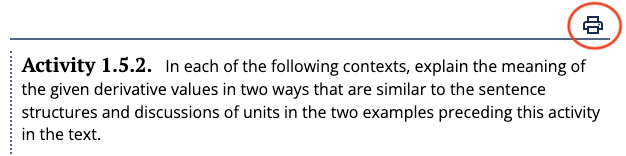
For example, if you look at Activity 1.5.2 in ACS2e, you’ll see a printer icon:

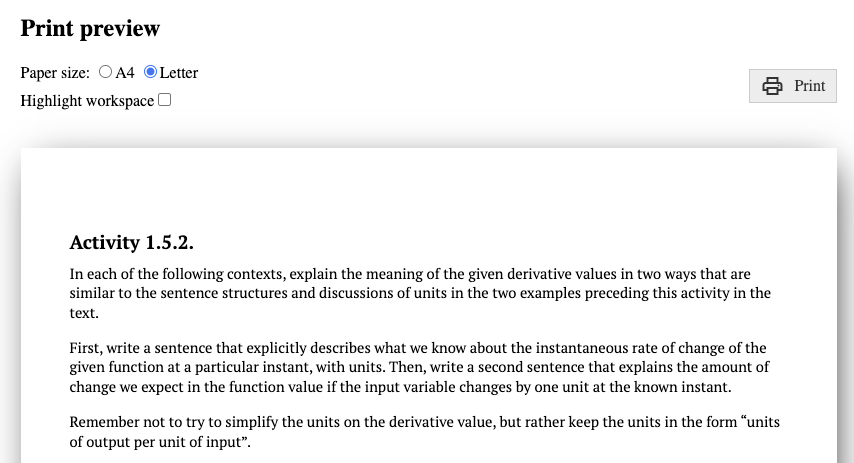
If you click the printer icon, you’ll see a preview of the PDF of the activity:

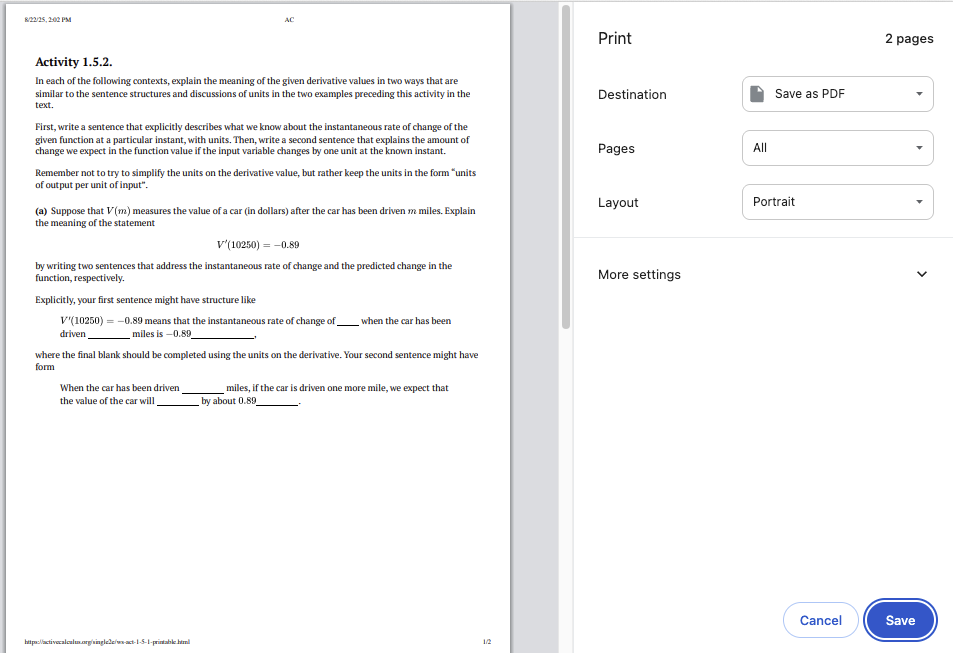
And finally, if you hit the print icon once more, you’ll see a dialog box with your printer, including the option to save the file as PDF:

If you only use a small number of activities from ACS2e or APC, this is a good way to make a few handouts for class. If you regularly use the activities, I think it’s more efficient to have your students use a print copy of the full workbook, which you can download in PDF from the landing page for each course (the direct links are ACS2e WB1-4, ACS2e WB5-8, APC WB).

The big advantage of this new worksheet environment in PreTeXt is that it provides space for students to work after each prompt, space that should be commensurate with the task. I wrote a bit about this a year ago when we used this feature to update the PDF workbooks; the 2e HTML is the first time we’ve had this in the HTML version as well. If you are interested in more of the technical details in how PreTeXt generates these worksheets and what’s possible, see this recent post by Oscar Levin.

Big thanks to Oscar for all of his technical work to make these worksheets function well in the HTML, as well as to Rob Beezer for supporting them in PreTeXt and doing the coding work to include them based on feedback from others. Worksheets are primarily an outcome of the 2024 AIM workshop at Franciscan University of Steubenville on PreTeXt for Small Documents, and many of the participants there contributed ideas that led to this feature.

Posted in Publishing, Resources, Teaching | Tagged , , | Comments Off on Printable worksheets for activities in ACS2e and APC

Updated ancillary resources for Fall 2025

See the note at https://activecalculus.org/instructors/ that takes you to the instructors’ Google group for more information and links to various resources.

Posted in Uncategorized | Comments Off on Updated ancillary resources for Fall 2025

Active Calculus Single – 2nd edition is available

I’m delighted to share that the 2nd edition of AC-Single has now been officially released in HTML and PDF: you can learn more at the landing page for this edition of the text at activecalculus.org/acs2e/, with the HTML version at activecalculus.org/single2e/.

Huge thanks go to production editor Mitch Keller whose technical expertise with PreTeXt (and much more) and understanding of the book have made a wide range of important changes possible; without his help, neither the HTML nor PDF versions would exist. Chrissy Safranski has also made major contributions to the 2nd edition, partly through extensive feedback on the text itself, as well as through providing key content and support for the WeBWorK integration in the Runestone version of the text. I’m deeply grateful to both Chrissy and Mitch, as well as to everyone else who has offered their feedback and support that have led to the changes in the 2nd edition that have certainly improved the text.

There has been some minor reorganization of the menu and web pages here at activecalculus.org to clarify the two editions. At the main menu site for Active Single (which used to point to the first edition), activecalculus.org/acs/, there’s brief discussion of the fact that there are now two editions, with links to both the second edition’s landing page (activecalculus.org/acs2e/) and the first edition’s page at activecalculus.org/acs1e/. Note that there’s a new (temporary) cover image for ACS2e that is intended to highlight when you’re looking at 2e vs 1e.

Posted in Uncategorized | Comments Off on Active Calculus Single – 2nd edition is available

Active Calculus – Multivariable: 2nd Edition Update

Over the past year, we have been busy working on what we plan to release as the 2nd edition of Active Calculus – Multivariable (ACM) in time for Fall 2026 classes. This post provides an update on our progress and plans, plus an invitation to interested instructors to pilot the updated text starting this fall.

To summarize this post: The new 2nd edition of ACM has been substantially reorganized, includes some new content, has integrated SageMath graphics throughout, and will only be available in electronic HTML form for the 2025–26 academic year for anyone interested in teaching from the 2nd edition in a pilot setting.  The first edition will remain fully available for the foreseeable future.  Read on for more detail.

History and 2nd Edition Overview

The 1st edition of ACM consists of chapters 9–11, written by Steve Schlicker, and chapter 12 on vector calculus, which we wrote. Steve’s chapters were originally written in LaTeX and designed for print/PDF output. PreTeXt enabled the HTML version that most now use, but these chapters have not had a graphics update to enable interactive 3D graphics from SageMath, which we used extensively in chapter 12.

Since Steve is now retired, we have taken over responsibility for the entirety of ACM. As we considered refreshing the graphics and other feedback from instructors, we decided that a 2nd edition that makes more significant revisions was an appropriate approach. The 1st edition will remain available on activecalculus.org, so instructors who do not wish to switch to the 2nd edition will not need to do so. (You will need to update links to point to the 1st edition after the 2nd edition is released, however.) Our focus from this point forward is on the 2nd edition, so typos reported in 1st edition text will only be fixed if that text also appears in the 2nd edition. However, we are happy to accept pull requests on GitHub if folks want to send them to fix typos in the 1st edition.

We have posted a separate page detailing how the 2nd edition will differ from the 1st edition. The 2nd edition of ACM has evolved because in reality, “multivariable calculus” can mean one of three different courses: one that follows chapters 9–11 of the 1st edition and omits vector calculus entirely; one that introduces students to line integrals, the Fundamental Theorem of Calculus for Line Integrals, and Green’s Theorem; and one that proceeds through all of that material plus Stokes’s Theorem and Gauss’s Divergence Theorem. As such, the extent to which certain topics in the new chapters 9–12 are necessary varies depending on the course’s final destination.

New for the 2nd edition of ACM will be an annotated instructor’s version, which is currently available in preview form. This version will not contain any answers or solutions that are not in the student-facing version. However, the start of most sections will contain notes for instructors about where a section’s content is used later on and how to move through a section more quickly, if needed. Occasionally, a note will appear in the margin of the instructor’s version that either expands on the notes at the beginning of the section or lets instructors know that there’s information in those notes relevant to that part of the text. We are still organizing this material, but the new Section 9.7 shows the structure.

Timeline for 2nd Edition

Instructors who are curious about the 2nd edition can see a preview. Throughout July 2025 and the first half of August 2025, further edits will be made to the flow of the writing and formatting of the contents, but the table of contents and structure of discussion and activities will not see significant changes before the Fall 2025 semester starts.

Throughout the 2025–26 academic year, updates will continue to be made to the version of the 2nd edition posted at this location as typos are caught and corrected. Any significant changes will be announced on our Google Group. Instructors interested in teaching from the 2nd edition or participating in a group that reads and gives feedback on it during this academic year should join the Google Group and see the pinned post for instructions on how to contact Nick.

During the 2025–26 academic year, we will not have a PDF version of the 2nd edition available. What solutions have been written can be provided to instructors as a PDF, just as we have done with the 1st edition. However, some solutions still need to be written as the semester goes along. (This would be a great way to give back to our open-source community if you’re interested! Join the ACM Google Group to keep up-to-date on progress and to discuss how to contribute.) An activities workbook will also not be available for Fall 2025. However, PreTeXt support for worksheets that can be printed from the browser has made significant progress, and we intend to have this available for the 2nd edition as a fill-in measure. (Look for further guidance on how to use this feature in August, once we enable it on the preview version of the 2nd edition of ACM. This feature is also coming to the 2nd edition of Active Single, which Matt posted about recently.) For Fall 2026 classes, we do intend to have a PDF/print version available as well as a PDF solutions manual for instructors and a PDF/print activities workbook.

You will likely notice that the 2nd edition needs additional exercises. Our first priority is to solidify and polish the narrative and activities for the changes in the 2nd edition before doing any additional work on exercises. Many sections already have WeBWorK and pencil and paper exercises. For sections with minimal exercises, we recommend the many publicly-available open resources to select computational and conceptual exercises that fit your needs for the time being. In particular, we recommend exercises from APEX Calculus or WeBWorK’s Open Problem Library in addition to problems from other well-known textbooks. Because the depth of coverage differs across the many different versions of multivariable calculus courses, you may also consider using activities not covered in class as excellent conceptual homework problems. 

We are excited to share the finalization of the 2nd edition of ACM with the community over the coming year!

Nick Long and Mitch Keller

Posted in calculus, updates | Tagged , , | Comments Off on Active Calculus – Multivariable: 2nd Edition Update